The handicap is golf's best invention: a single number that lets a beginner and a club champion play a genuinely fair match for five bucks. It's also buried under two decades of outdated explanations, because the entire system was replaced in 2020 and most advice online — and most advice in your foursome — still describes the old one. Here's your golf handicap explained, current system, no math degree required.
What a Handicap Actually Is
Your Handicap Index is a number (say, 21.4) that estimates your demonstrated potential — roughly what you shoot on a good day, not your average day. Two big implications beginners miss:
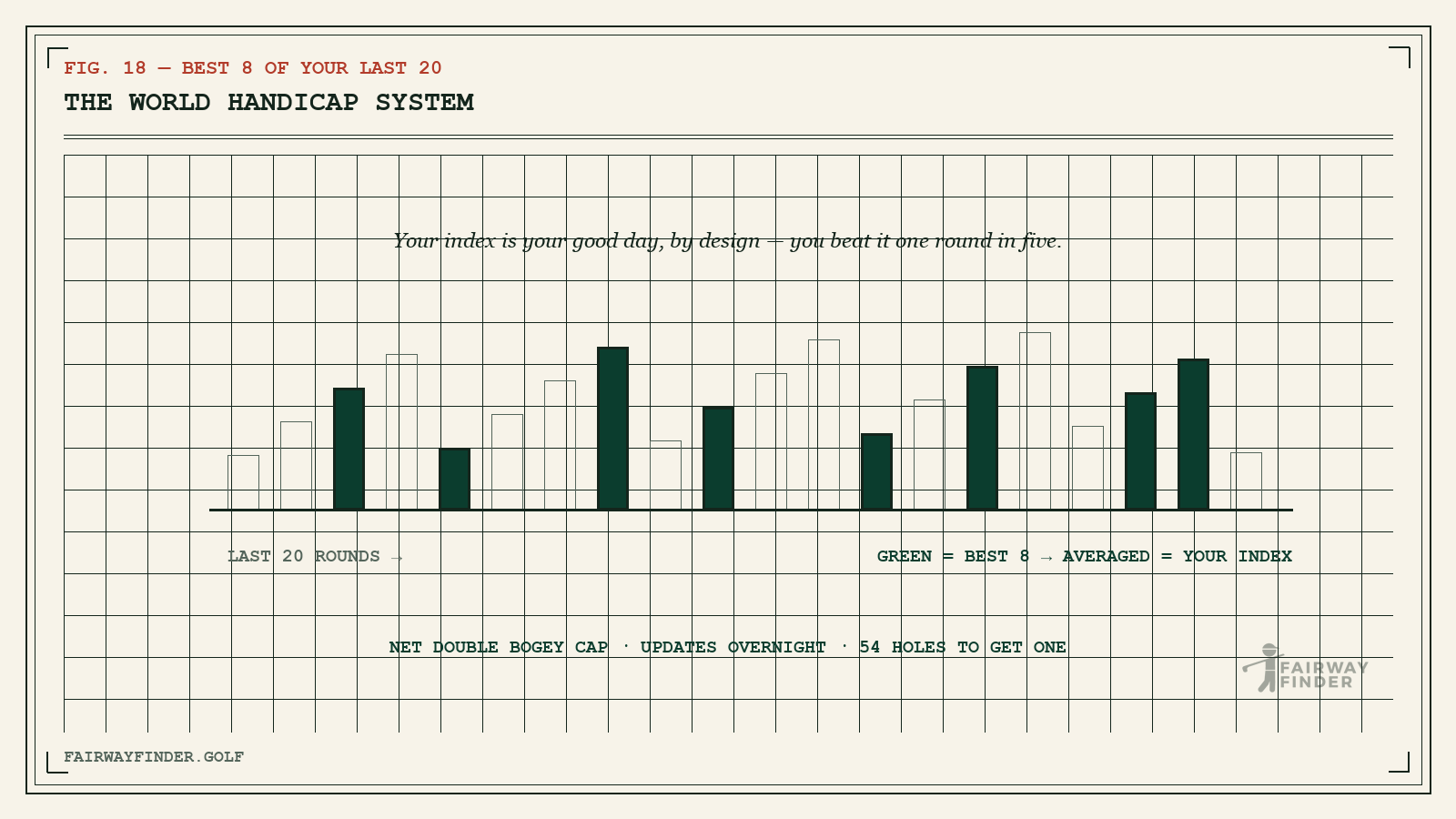
- You will NOT hit your handicap most rounds. By design, you'll play to it or better only about one round in four or five. If your index is 20 and you usually shoot 95–98, the system is working exactly as intended.
- It's a measure of potential, so it drops fast when you improve and rises slowly when you struggle — the system deliberately believes in your good rounds more than your bad ones.
How the Number Is Built (One Paragraph, Promise)
Under the World Handicap System (WHS — the 2020 replacement for the old national systems), your index is the average of your best 8 score differentials out of your last 20 rounds. A "differential" is your score adjusted for how hard the course was that day. That's it. Old-timers may describe averaging your best 10, multiplying by 0.96, or "ESC" scoring caps — all retired. If the explanation you're hearing includes those, it's the old system.
Three modern details worth knowing:
- Your bad holes get capped. For handicap posting, the worst you can take on any hole is a net double bogey (double bogey plus any handicap strokes you get there). That blow-up 9 doesn't wreck your index.
- It updates overnight, every round. No more waiting for the 1st and 15th of the month (another retired relic).
- You can post 9-hole rounds. They combine or scale into your record — great for after-work golfers.
Handicap Index vs. Course Handicap (the Part Everyone Fumbles)
Your Handicap Index travels with you; your Course Handicap is what it converts to on a specific course from a specific set of tees. A 21.4 index might play as a 19 from the forward tees of an easy course and a 25 from the back tees of a beast.
The conversion uses two numbers printed on every scorecard:
- Course Rating — what a scratch (0-handicap) golfer would be expected to shoot from those tees.
- Slope Rating — how much harder the course gets for ordinary golfers relative to scratch (55 to 155; 113 is the neutral baseline). High slope punishes misses; it doesn't just mean "long."
You don't calculate any of this by hand — the course posts a conversion chart, and every handicap app does it instantly. Just know: comparing raw scores across different courses without slope is meaningless, which is why "I shot 92, what did YOU shoot" is a bar conversation, not a competition.
How to Get a Handicap (It's Cheap and Takes One Round Cluster)
The gatekept-country-club era is over:
- Join any golf club OR an online/state golf association program — typically $30–60 a year. In the US that gets you an official GHIN number; other countries have equivalents.
- Post 54 holes in any combination (three 18s, six 9s) and you have an official index the next day.
- Post honestly from then on: every real round, good and bad. The system's math handles the rest.
Can you keep an informal handicap with a free app instead? Sure — fine for buddy games. But the official one is what club events, leagues, and tournaments accept, and at the price of a dozen lake balls a year, it's worth it.
Using It: Strokes, Matches, and Where They Land
In a match, the difference in course handicaps determines strokes given: if you're a 24 and your buddy's a 15, you get 9 strokes — one each on the 9 hardest holes, per the handicap row on the scorecard (that mysterious 1–18 numbering finally explained: 1 is the hardest hole, 18 the easiest). On those holes, your 6 becomes a net 5.
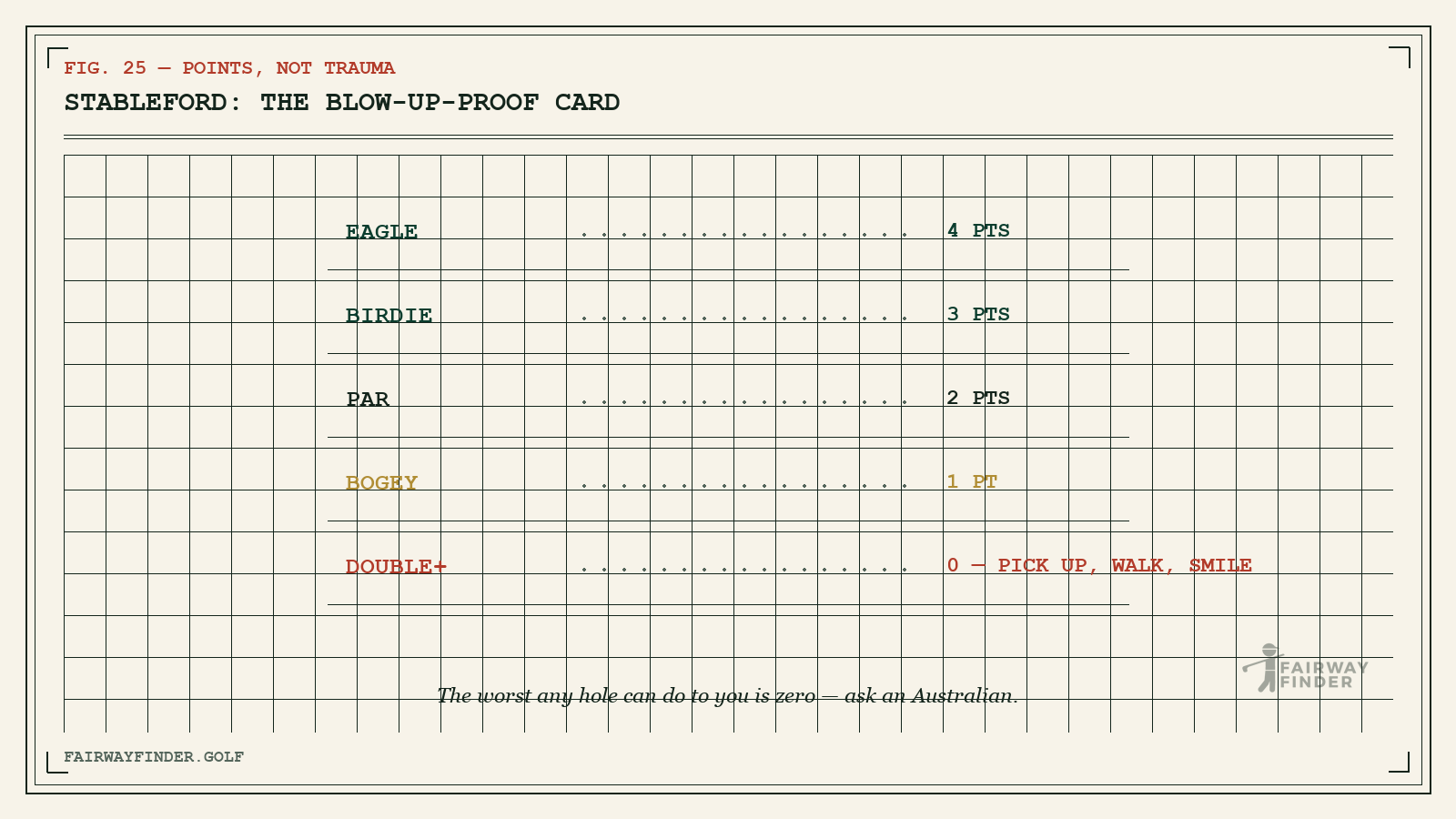
For fun formats that use handicaps well — stableford, best ball, and the rest — see golf formats that make golf fun.
Handicap Culture: Two Sins and a Virtue
- Sandbagging — inflating your handicap by posting selectively (or "forgetting" good rounds) to win bets. Golf's cardinal social sin.
- Vanity capping — the opposite: not posting bad rounds to keep a flattering number. More common, equally corrosive, mostly self-inflicted.
- The virtue: post everything, immediately, including the disasters. A true handicap makes every game you'll ever play more fun — and watching the number fall is the single most satisfying progress tracker in golf.
One last reframe for new golfers: a 30 handicap isn't an embarrassment, it's a baseline. The average male index hovers around 14 after years of play; arriving anywhere near that is a real achievement. Get the number, then go earn its decline — starting with the club that finds short grass more often. The fastest handicap-droppers fix their tee shot first; our guide on how to hit more fairways is the place to start.
Ready to find more fairways?
The Fairway Finder driver — 43.5" control length, 460cc titanium, 11° high launch, oversize leather grip. $299 USD / CA$399 with headcover and 1-year warranty.