Ask golfers what ruins a round and the answer is never "my partner shot 105." It's the 4-hour-45 death march behind a group treating a Tuesday muni round like the final pairing at a major. Pace of play is golf's biggest solved-but-unimplemented problem — solved because the fixes are known, simple, and none of them involve rushing your swing. Here's the ready golf playbook: what the modern standard actually is, and the specific habits that make you the fast player everyone loves being paired with.
Ready Golf Is the Official Standard Now (Not a Hack)
Old golf taught "honors": the previous hole's winner tees off first, farthest from the hole always plays first, and everyone else stands politely idle. That protocol still governs formal match play — and in casual stroke play it is officially, explicitly retired. The modern Rules of Golf actively encourage "ready golf" in stroke play, and the pace guidance is blunt: play when ready (safely), and hit your shot in about 40 seconds once it's your turn, ideally faster.
So when someone waves you off with "you're not away" on a Saturday, they're enforcing an outdated custom the rulebook itself moved past. Be polite about it. Be fast about being polite.
The Real Cause of Slow Play (It Isn't Bad Golfers)
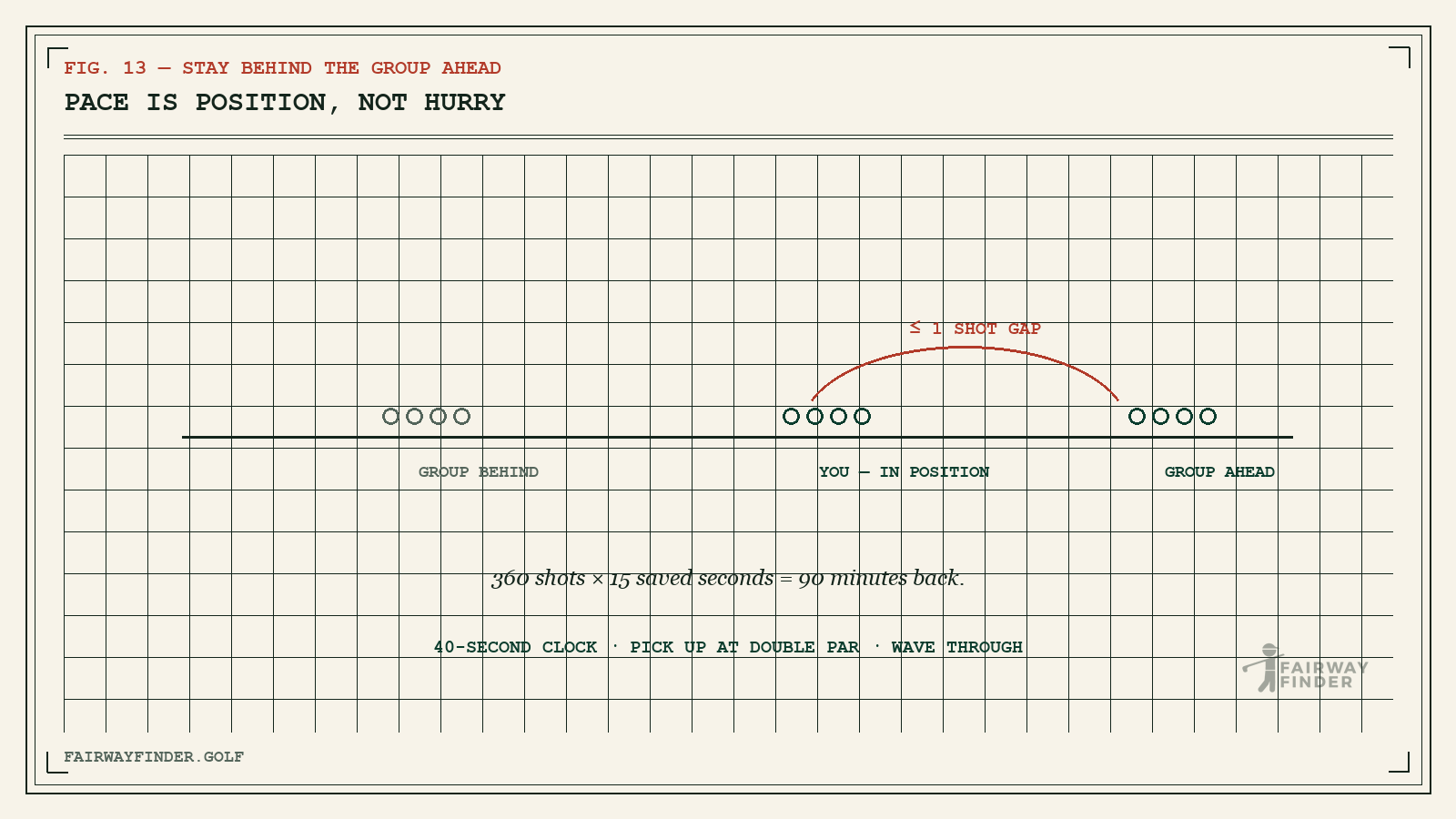
Do the math that changes everything: a foursome hits roughly 360 shots in a round. Save just 15 seconds per shot — not by swinging faster, but by being ready — and the round shrinks by an hour and a half. Slow play is never the swing; it's the dead air between swings: the guy who starts thinking about club selection only when he arrives at his ball, the green-side bag left on the wrong side, the scorecard filled out on the green while the next group waits in the fairway.
Skill is innocent. A fast 110-shooter finishes ahead of a slow 85-shooter every single time.
The 12 Habits of Fast Golfers
Between shots
- Do your prep — yardage, club, wind, decision — while others play, not when your turn arrives. Arrive at your ball ready to swing.
- Walk with purpose to YOUR ball directly (not caravanning to each ball together, cart or on foot).
- In a cart: drop your partner at their ball with a couple of club options, drive to yours, play, circle back.
- Carry two or three clubs from the cart on path-only days. The walk back for a different club is the day's biggest silent time thief.
On the tee
- Shortest hitter can tee off first while the long hitter waits for the fairway to clear — ready golf's most useful trick.
- Watch every tee shot to its landing spot, yours AND your partners'. Four spotters means no five-minute searches.
- Trouble likely? Announce and hit a provisional immediately. The walk-back-to-retee is a pace catastrophe the provisional erases.
Around the green
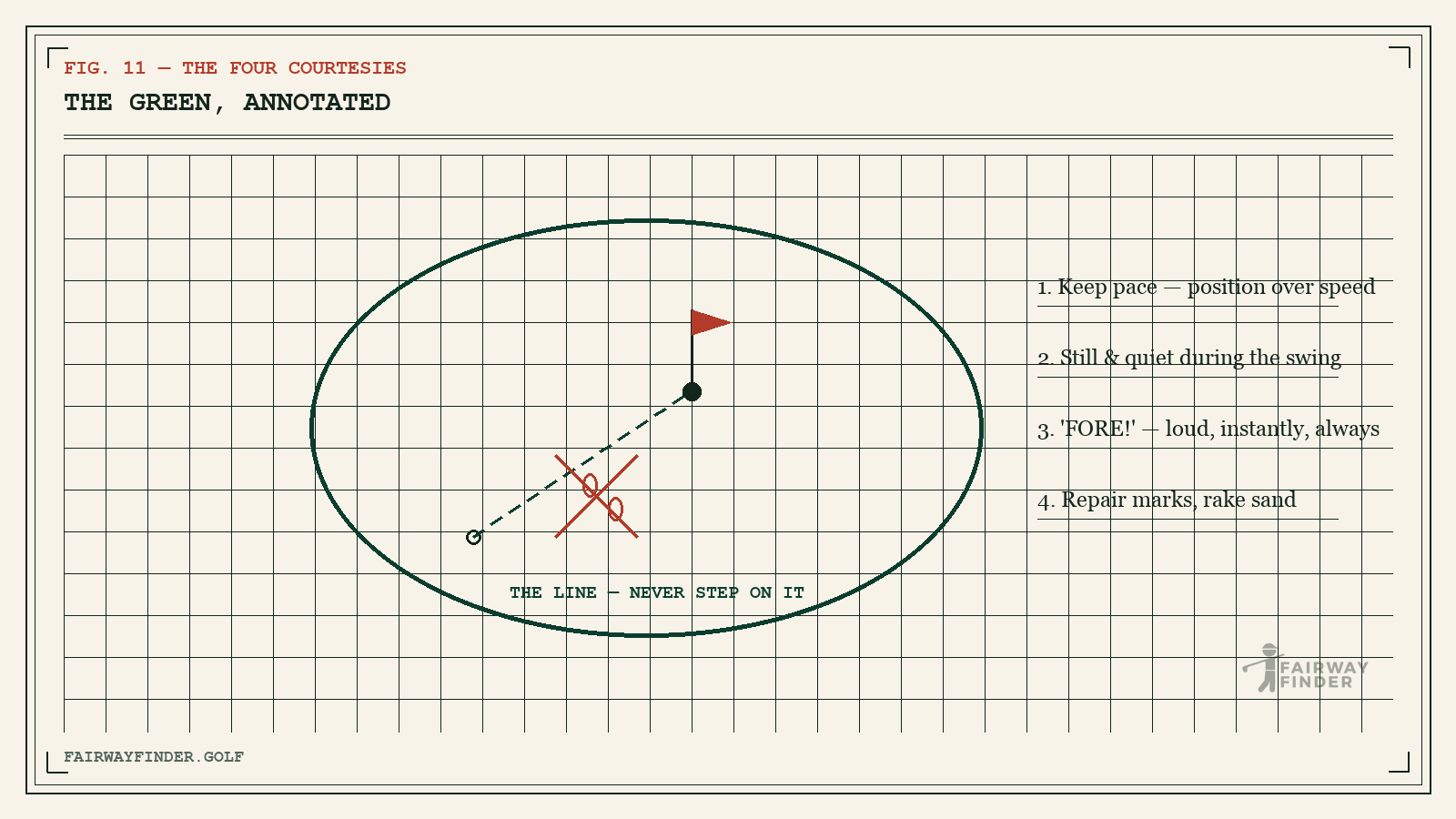
- Park your bag/cart on the exit side toward the next tee, never in front of the green.
- Read your putt while others putt (without shadowing their line). Continuous putting — finishing the 2-footer instead of marking it — is fine in casual play.
- Leave the green immediately when the hole's done; scorecards get written on the next tee. The group behind can't hit until you're gone.
The safety valves
- Pick up at double par in casual rounds. Write the max, walk, smile. It's the accepted custom everywhere (and in Stableford it's literally built into the format).
- Cap searches at 90 seconds. The rules allow three minutes; your Saturday doesn't need them.
Position, Not Speed: The One Metric
The pace standard isn't a stopwatch — it's position: stay directly behind the group in front of you, not merely ahead of the group behind. If the fairway ahead is empty and carts are stacking up behind, your group is the problem, however "normal" your pace feels. The remedy is the classiest move in golf: wave the faster group through (par 3s and turns are the natural spots), or simply skip ahead to the open hole and circle back. Letting a group play through costs five minutes and buys you a relaxed back nine; being stalked by an irritated foursome for three hours costs far more.
And a note for the fast player stuck behind slowness: one polite ask at the turn ("mind if we play through when there's a gap?") is fair game; passive-aggressive fairway-crowding is not. The marshal exists — use the pro shop, not vigilante justice.
Fast Feels Better (the Selfish Case)
Here's what pace evangelists undersell: ready golf isn't a sacrifice for others — it plays better. Standing over a shot for 90 seconds is where doubt lives; athletes in every sport perform better in rhythm. See target, pick club, one rehearsal, go — the 30-second version of you swings freer than the 2-minute version, guaranteed. Less standing around also means fewer cold muscles (pair this with the 10-minute warm-up and your body stays in the round).
And the equipment footnote that belongs in any honesty-first pace guide: nothing slows a round like the tee shot into the trees and the expedition that follows. More fairways is the ultimate pace-of-play hack — which is, not coincidentally, the entire design brief of our driver. Keep it in the short grass and the whole course speeds up behind you.
Play ready, stay in position, pick up when it's gone, wave through when it's right. Four hours becomes three and a half, and everyone — including your scorecard — has a better day.
Ready to find more fairways?
The Fairway Finder driver — 43.5" control length, 460cc titanium, 11° high launch, oversize leather grip. $299 USD / CA$399 with headcover and 1-year warranty.